A new chapter for our forthcoming Tamil translation of the Power of Facilitation, co-authored by Tamil translators Ramesh Srinivasan and Dr Nalini Rajesh.
The Business Context
Organisations often reach a point where the very approaches that drove their past growth may no longer be sufficient to take them into the future. The client organisation was at a significant inflection point in its growth trajectory, as it planned its transition from project-based solutions towards a more scalable, product-led SaaS model.
The Client is a sustainability data-intelligence organisation that brings together data, technology, artificial intelligence and sustainability expertise to help organisations make better, more informed decisions. Its software platform is positioned as a unified intelligence platform, with solutions spanning sustainability performance, operational resilience, supply-chain performance, risk and impact. The organisation currently serves multiple industries and has a footprint extending across continents.
The shift in its approach to customer engagement is more than a change in the technology or commercial model. It has implications for the way the organisation understands its customers, delivers value, works across functions and thinks about the customer journey.
In a project-based environment, teams can often work around the specific requirements of an individual customer. Each engagement may have its own context, expectations, adaptations and solutions. However, a product-based SaaS model calls for a different level of consistency and repeatability.
The organisation needs to think beyond delivering a solution to one customer and increasingly ask, “How do we create a customer experience and delivery system that can work consistently, effectively and at scale ?”
This raises important questions for teams across the organisation.
- What does the customer experience look like from beginning to end ?
- Where are the critical points in that journey ?
- Where can the experience be strengthened ?
- Where and how do different functions need to work more closely together ?
- And, most importantly, how can the organisation collectively create a delivery model that is scalable while continuing to create value for the customer ?
It was against this backdrop that a facilitated internal learning session was designed for the client team consisting of members from cross-functional areas.
From a Business Challenge to a Facilitation Opportunity
During the briefing session, the Founder & CEO of the organisation emphasised, “this is a major transition and hence we would like all the crucial team members to own it. We don’t want this to be seen as a ‘top-down’ directive with a scope for fragmented implementation.
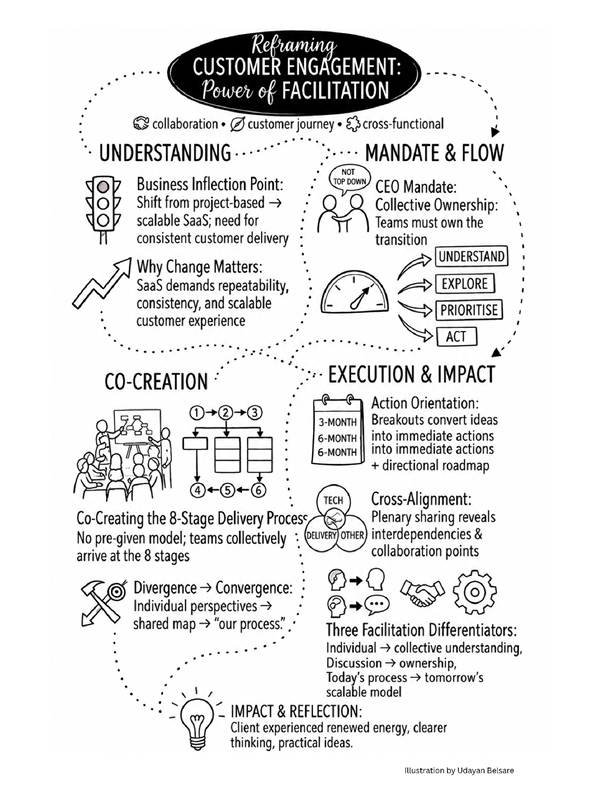
Keeping this in mind, the virtual session, titled “Reframing Customer Engagement”, was facilitated on 4th February 2026. The stated purpose was not simply to discuss customer engagement, but to enable the teams to collectively examine the customer delivery process, identify opportunities for improvement and translate their insights into actions.
The desired outcomes were clearly defined:
- To develop a shared blueprint of the current customer delivery process across all eight stages and identify two or three priority opportunities for strengthening it.
- To develop a short, co-owned delivery improvement roadmap for the Technology and Customer Delivery teams, with clear actions for the next three months and directional actions for six months, aligned to specific delivery stages.
The design therefore deliberately moved from
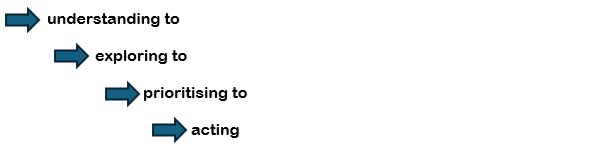
When an organisation is changing the way it creates and delivers value, the answers cannot always come from one function or one level of the organisation. The people involved in technology, customer delivery and other parts of the value chain see different aspects of the customer experience.
Rather than providing the participants with a pre-designed solution, the facilitation created a space in which the people closest to the work could collectively examine the process, bring their perspectives to the table and develop their own way forward. This was particularly important in the context of the Client’s organisational transition.
Facilitation therefore became a mechanism for bringing these perspectives together.
Creating the Space to Think Together
Facilitation is not merely about putting a process on a screen and asking people to respond. It begins by creating the conditions in which people are ready to participate.
The session was deliberately designed as both a divergent and convergent process. First, participants brought their individual understanding, experiences and perspectives into the conversation.
Then, through facilitated dialogue, these different perspectives were brought together to create a common understanding of the customer delivery process.
The objective was not simply to produce a process map. The deeper objective was to create shared ownership of the process.
When a process is designed by someone and handed over to a team, it can remain someone else’s process. When the people who execute the process collectively examine it, challenge their understanding, identify gaps and arrive at a shared view, it becomes their ‘collective’ process. That shift from “the process” to “our process” is one of the important contributions that facilitation made to organisational change.
From Mapping the Process to Owning the Future
Once the participants had developed a common understanding of the customer delivery process, the facilitation moved from exploration to action.
Participants were placed into breakout rooms and invited to discuss what they could do over the next three months, as well as the directional actions they would need to consider over the following six months, in order to implement and strengthen the eight-stage customer delivery process.
This was an important design choice. The session could easily have ended with an interesting discussion and a well-developed process map. Instead, the conversation moved towards: “So, what are we going to do about it?”
The three-month horizon brought immediacy and accountability. The six-month horizon encouraged participants to think beyond immediate fixes and consider the direction in which the delivery model needed to evolve.
The emphasis was therefore not merely on generating ideas, but on converting collective thinking into co-owned actions.
Bringing the Conversation Back Together
Following the breakout discussions, participants returned to the plenary to share their action points. This allowed the different teams to hear what others were thinking and helped surface areas of alignment, interdependence and possible collaboration.
The concluding reflections reinforced the importance of the eight-stage customer delivery process and brought the conversation back to the larger purpose of the intervention.
What Made the Facilitation Different ?
The value of the session was in creating the conditions for the organisation to find better answers collectively. Three aspects were particularly significant.
- From individual understanding to collective understanding – Different people experience the customer journey differently. Technology Team may see one part of the process, Customer Delivery Team may see another. The facilitated process brought these perspectives together and created an opportunity to develop a shared understanding.
- From discussion to ownership – The session did not stop at identifying what the customer delivery process should look like. The participants themselves developed actions for the next three and six months. This created a stronger connection between understanding the process and taking responsibility for improving it.
- From today’s process to tomorrow’s model – The organisation is navigating a larger business transition. As the client increasingly builds scalable product and platform capabilities, the customer experience cannot remain dependent only on individual project execution. The organisation needs to learn how to create repeatable, scalable and continuously improving ways of working.
The facilitation therefore served as a small but meaningful intervention in a much larger organisational journey.
The client’s Reflection
The impact of a facilitated conversation is often best understood not through the facilitator’s description of what happened, but through what participants experience afterwards.
The client subsequently reflected publicly on the session as an engaging session that created space for “honest dialogue, fresh perspectives and collective problem-solving”. The reflection also highlighted three outcomes that are particularly relevant to the purpose of the intervention: (a) renewed energy, (b) clearer thinking and (c) practical ideas to strengthen the way the team works together.
These are powerful indicators of what facilitation can create. The session created a space for people to pause, step back from their immediate operational responsibilities, look at the larger system, listen to different perspectives and collectively think about how they could work better together.
Facilitation as an Enabler of Business Transformation
Organisational transformation is often described through technology, processes, structures, products and business models.
But beneath all these changes are people. People need to understand the change. They need to see how their work connects with the larger system. They need opportunities to question existing ways of working. They need to hear perspectives different from their own. And, importantly, they need to participate in shaping what comes next.
This is where facilitation played a powerful role. In this session, the facilitators did not prescribe the customer delivery model. They created a structured environment in which the participants could collectively examine the current process, develop a shared understanding, identify opportunities and move towards action.
The result was not simply a process discussion. It was a conversation about how the organisation could work better together while preparing itself for the next phase of its business journey.
The Larger Lesson
The client experience demonstrates an important principle of facilitation: When people are given the right space, structure and opportunity to think together, they can become co-creators of the solutions they need.
The challenge is not merely to build better products. It is to build the organisational capability to continuously learn, adapt, collaborate, and improve.
Facilitation can become one of the mechanisms through which that capability is developed. In this case, a 90-minute facilitated conversation became an opportunity to step back from the immediacy of daily work, examine the customer delivery process collectively and begin translating shared understanding into action.
That is the power of facilitation in a business transformation journey.
Authors
Ramesh Srinivasan, Endorsed™ Facilitator
Ramesh Srinivasan is an IAF Endorsed™ Facilitator, Certified Leadership Coach and practicing facilitator with close to three decades of experience across leading organisations in India and the Middle East. He has been continuously practising facilitation across organisational, leadership, business and learning contexts, working with leaders, teams, professionals, faculty and diverse stakeholder groups.
His facilitation practice is grounded in the belief that effective facilitation creates the space for people to think together, surface diverse perspectives, engage in meaningful dialogue and collectively move towards purposeful action. His work spans leadership development, strategic alignment, organisational development, competency management, team effectiveness and other complex organisational interventions.
Ramesh has been associated with the International Association of Facilitators (IAF) in various capacities over the years, contributing to initiatives at both the chapter and global levels. These experiences have given him opportunities to engage with fellow facilitators across geographies and to contribute to the continuing development and visibility of facilitation as a professional practice.
He is particularly interested in advancing the practice of facilitation in the Indian organisational and cultural context and has co-authored the book “Holding Space, Shaping Futures – Facilitation in the Indian Context”, an exploration of facilitation practice across organisational, leadership, academic, social-sector and other contexts.
In addition to his IAF Endorsed™ Facilitator credential, Ramesh is a Certified Leadership Coach, an AQai Adaptability Quotient (AQ) Level 2 Professional Coach, a Thomas International PPA practitioner and a Lean Six Sigma Black Belt. He brings these complementary perspectives into his facilitation practice, integrating facilitation, coaching, behavioural science and process excellence to help people and organisations navigate complexity, change and growth.
Dr. Nalini Rajesh
Dr. Nalini Rajesh is an HR and ESG Consultant, Trainer, Faculty and Facilitator with over 25 years of rich industry experience across reputed organisations in India. She holds a PhD in Management Studies, MBA and BA (Economics) and has built a diverse career spanning Leadership Hiring, Performance Management, Career & Succession Planning, Change Management & Continuous improvement initiatives, Learning & Development and TQM.
A significant part of Nalini’s professional journey has been dedicated to developing people and enabling organisations to navigate change and growth. Having led Learning & Development for over a decade, she has designed and delivered interventions for people at levels across organizations, from Leaders to Executives. Her work encompasses leadership development, team effectiveness, managerial effectiveness, conflict resolution, communication, mentoring, competency development and employee engagement.
As a trainer and facilitator, Nalini believes that meaningful development happens when people are given the opportunity to participate, reflect, share perspectives and learn from one another. Her experience of working with diverse groups across organisational levels has strengthened her interest in creating spaces where people can engage in dialogue, build shared understanding and translate insights into purposeful action.
A Visiting Faculty at the University of Madras, she teaches MBA students in Strategic Management, Marketing Management and International Human Resource Management. She is the Founder & Senior Consultant of Unique Ventures, providing consulting interventions in HR, Organisational development and ESG.
For over a decade, Nalini has championed Corporate Social Responsibility and volunteering initiatives, bringing together people and organisations to create meaningful social impact.
She is a Certified Coach (ACC-ICF), POSH Consultant, with additional certifications in Story Telling, Thomas Profiling, Assessment Centres, MBTI, Six Sigma, and ESG.
Her journey across HR, People development, TQM, L&D, CSR, Teaching, Training and Facilitation reflects a continuing commitment in helping individuals, teams and organisations discover their potential, navigate change and move forward together.
Visual Practitioner
Udayan Belsare
Udayan Belsare is a Visual Facilitator, Graphic Recorder, and multidisciplinary professional working at the intersection of visual thinking, facilitation, and structured problem‑solving. He helps teams, leaders, and organizations make sense of complex ideas through clear, engaging visual narratives that enhance alignment, participation, and decision‑making. With extensive experience supporting corporate workshops, leadership conversations, learning programs, and strategy sessions, Udayan brings a unique ability to translate discussions, frameworks, and insights into hand‑drawn and digital visuals that simplify complexity and strengthen shared understanding.
Professionally, Udayan has a strong foundation in business research, enterprise solutions, and stakeholder engagement within technology‑driven and knowledge‑intensive environments. This background enables him to bridge analytical thinking with creative expression, making his visual work both conceptually rigorous and intuitively accessible. His practice integrates facilitation principles, systems thinking, and continuous learning, reflecting his belief that visuals are not decoration but powerful cognitive tools that support clarity, collaboration, and long‑term retention. Through his work, writing, and teaching, Udayan aims to make learning practical, accessible, and memorable for professionals, educators, and facilitators. He is committed to helping individuals and teams think better together—using visuals to unlock insight, accelerate problem‑solving, and build shared meaning in fast‑moving, complex environments.


You must be logged in to post a comment.